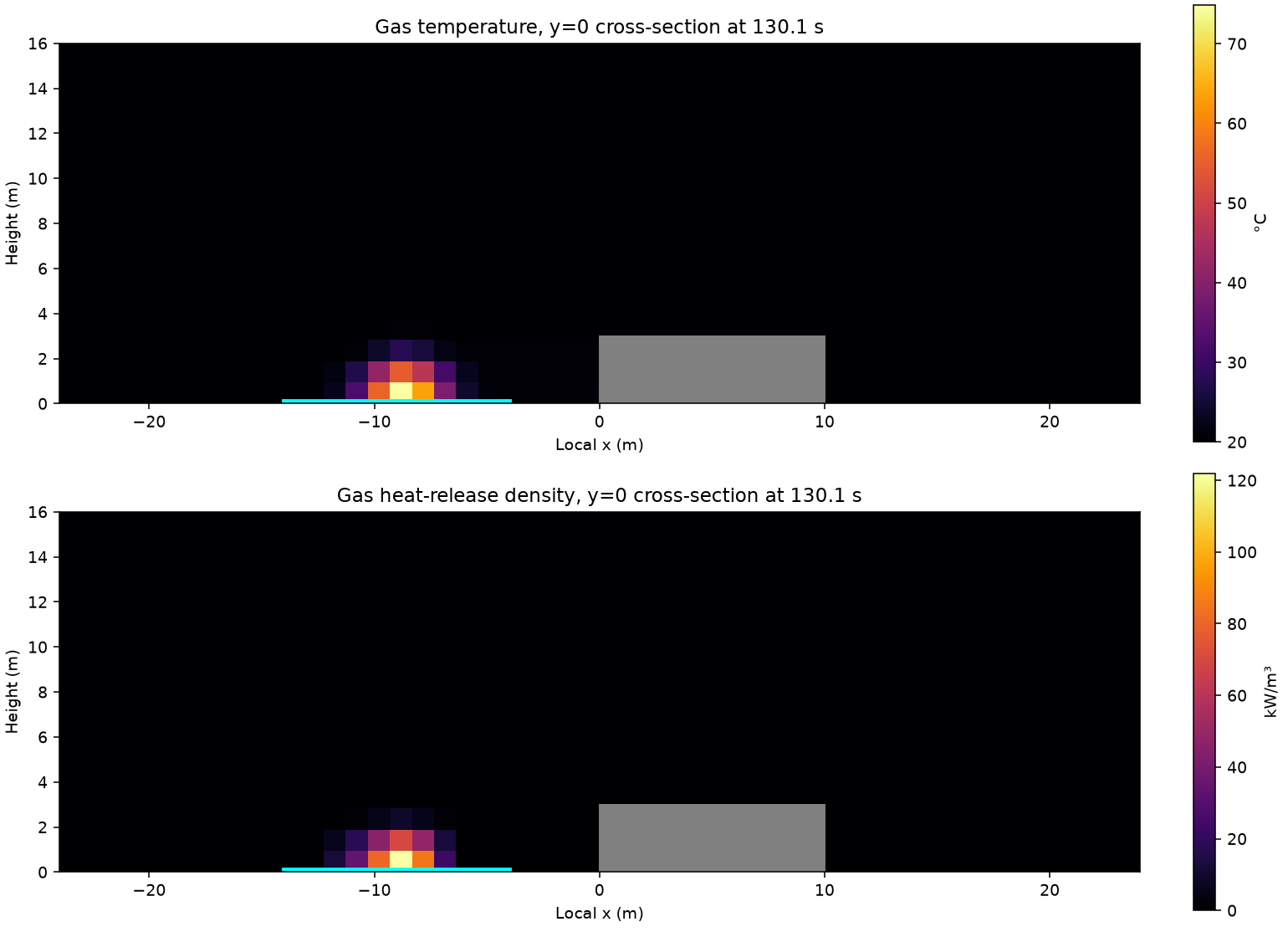
One center-plane slice only: the southwest wind also transports the plume out of this plane. Gray box is the house; cyan line is the source footprint.
CFD prototype: wind-driven fire exposure, embers excluded

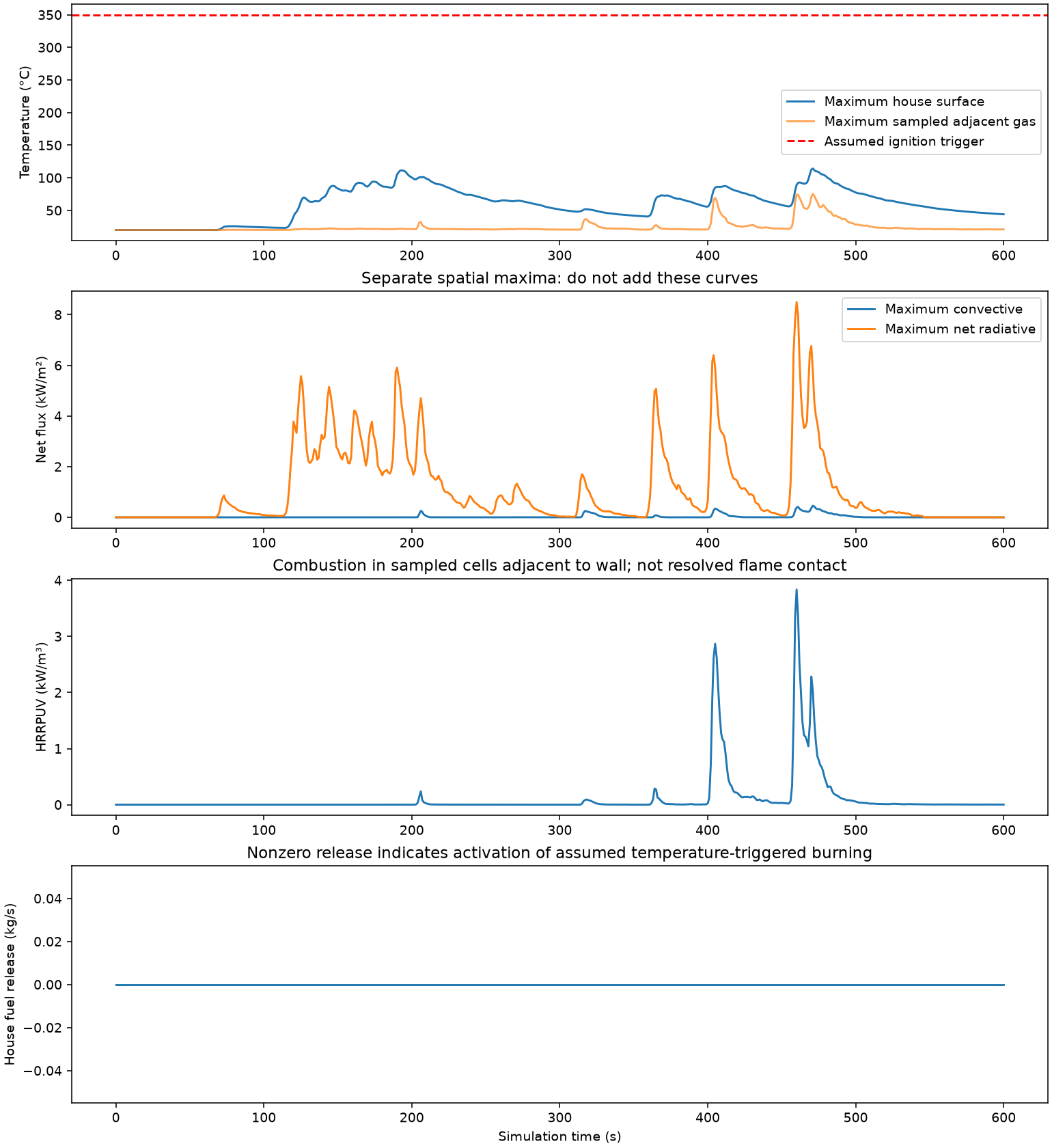
The assumed house burning trigger did not activate during the 600-second run.
This is an exploratory FDS calculation with assumed materials and coarse resolution. It is not a validated ignition or survival prediction for a property.

RESULTS
Maximum reported house surface temperature: 114.2 C.
Maximum sampled adjacent-gas temperature: 75.4 C.
Maximum convective heat flux: 0.46 kW/m2.
Maximum net radiative heat flux: 8.50 kW/m2.
These flux maxima can occur at different locations/times; do not sum them. Net radiation is not the same quantity as incident radiation in the preceding simplified screen.
Maximum sampled near-wall gas heat-release density: 3.836096 kW/m3. A small positive value alone does not demonstrate flame impingement; flame contact itself is not resolved at a 1 m grid. Sampling does not cover every gas cell.
Integrated solver combustion: 1111.5 MJ versus prescribed patch energy 1111.2 MJ. The solver total includes house combustion if its trigger activates; transport/extinction and output sampling can also affect this comparison.

WHAT CHANGED
FDS solves buoyant reacting gas flow, transport, radiation and convective exchange with solid surfaces. The original 25-cell fuel-loss histories drive 25 separate 2 x 2 m ground burners, using assumed effective release 16 MJ/kg and propane as a gas combustion proxy. Linear interpolation between interval midpoints conserves total prescribed source energy; sharp one-second changes are smoothed. Atmospheric-energy fields are not added again. Burners represent energy release, not validated vegetation flame shape or chemistry.
Wind comes FROM 230 degrees, with 5 m/s at 10 m and an imposed neutral logarithmic profile with 0.01 m roughness. The solver creates the building/plume interaction rather than reusing fire-perturbed winds. The source patch is 4 m west of the synthetic 10 x 8 x 3 m house. Original coordinates are translated, not geographically registered to a real property. No ember particles or firebrand generation are present.

HOUSE ASSUMPTIONS
All exterior faces use generic 20 mm wood thermal properties: k=0.12 W/m/K, cp=1500 J/kg/K, density=500 kg/m3, emissivity=0.9, insulated rear. Initial/ambient temperature is 20 C. At 350 C, each face cell begins a prescribed burning ramp to 150 kW/m2 over 10 seconds, with assumed vaporization energy 1000 kJ/kg. This is a temperature-triggered burning surrogate, not calibrated charring-wood pyrolysis. Post-trigger burning is prescribed and not evidence of self-sustained real wood combustion. No finite fuel burnout is specified for the house. Combustion uses FDS mixing/extinction defaults; no independently calibrated pilot/autoignition mechanism is represented.

LIMITATIONS
1 m grid, 48 x 40 x 16 m domain, 30,720 cells. No grid or domain convergence demonstrated. A 0.5 m input deck is prepared but not run. Ground fuel is represented as burner surfaces, not 1 m-tall distributed vegetation. Source wind/spread feedback remains one-way: prescribed QUIC-Fire fuel loss does not change when this house is added. No surrounding burning cells, windows, cavities, realistic roof assembly, eaves, moisture evolution, ember ignition, structural failure or interior fire. The original reference experiment has not been reproduced with this solver. No insurance risk probabilities can be inferred.

VERIFICATION AND REPRODUCTION
Official FDS 6.11.1 Windows archive SHA256: 302ec837caaea8cb990cece085bee2284a0338d64fac0b77d46749a92ab12dfc (matched published release digest). Extracted locally without running the system installer. Short 5-second setup runs passed. Full serial run completed normally at 600.0 s. All device values finite and times increasing. See house_serial.out for solver diagnostics and source assumptions.json. Earlier house_1m run was intentionally stopped during timing; it is NOT the final result. A concurrent timing attempt encountered an MPI shared-memory error; final run uses one process and completed normally.
Use build_cfd.py to regenerate base input decks; house_serial.fds is the executed deck (same physics as house_1m, different output name). Run fds.exe house_serial.fds in a new output directory, with bundled bin/mpi on process PATH; analyze using analyze_cfd.py. Local cloud spend: $0.

Sources
Official release: https://github.com/firemodels/fds/releases/tag/FDS-6.11.1
User guide source: https://raw.githubusercontent.com/firemodels/fds/FDS-6.11.1/Manuals/FDS_User_Guide/FDS_User_Guide.tex
Guide sections: Wind Method 1; Thermally-Thick Solids that Burn at a Specified Rate. Documentation defines the implemented controls; it does not validate our selected parameter values.